I've been a bit slack of late, and somewhat lacking in matte motivation, which given my temperament isn't a surprise for anyone who knows me personally. Lots of posts on the back burner and some more or less ready to go, but I'm the sort of fella who always puts off till 'tomorrow' what might be better carried out 'today' - that is until the proverbial 'stars are in alignment' and the kama is tuned (!), and all the so called creative juices flow like the Japanese Tsunami (maybe that's a bad example... but I'm sure readers will get my drift). I find that those big articles can be trying at the best of times, especially with the 'Blogger' machinery which is very unreliable and simply cannot be relied upon to always save the material during it's preparation. Drives me to distraction! :(
![]()
I'm very happy with the feedback I received from my recent Shepperton mega blog - and as always I'm grateful to those dedicated fellows out there who send me amazing material (from where, I've no clue!). Well what's on the agenda today?..... Well, shock of shocks, today's big effects extravaganza retrospective barely falls within the matte category, with just
one major matte shot and a small second 'top up' shot comprising all there is paint on glass wise. It's not that I've run low on matte material (you wouldn't believe how much I have....
(over 80 GB of just images alone) but often I feel justified in examining effects shows that I love and as with today's film, were
entirely justified in achieving FX Oscar status.
For matte afficienados I must wholly recommend the excellent 90 minute documentary my pal Dennis Lowe has produced on the careers of long time British matte team Doug Ferris and John Grant. Plenty of great stories and behind the scenes info which is a must for fans of the British matte industry. Click
here for that.
![]()
My Dad took me to see
TORA, TORA, TORA back in it's initial release in 1970 - where I'm fairly sure it was a 70mm release - at the now deceased
Cinerama theatre in Auckland, on the giant curved screen - a relic from the short lived 3 projector system of the early 60's. As a lad who loved war films and play acting war scenarios with my mates in the dense bush near our house, where camoflage and guerilla style jungle warfare was our kick (though none of this in any way pertains to TORA's naval scenario). But these were the days when TV was black and white, movies were double bills, kids got covered in mud and scratches and the dreaded PlayStation style of 'living room combat' was still a quarter of a century (or more) away. ...as usual, I digress.
Damn..........did TORA make an impact upon me! I loved it. Even on extraordinarily bizzare 1 o'clock Saturday double bills (paired inexplicably with Adam West's BATMAN or Jerry Lewis' THE DISORDERLY ORDERLY (!!) more often than not at the luxurious - and sadly now gone Mayfair cinema in suburban Sandringham, Auckland) I'd always try to catch it, even if it meant wandering out into the late afternoon daylight after it all with bloodshot eyes and stiff neck from sitting too near to the screen - with the oddly paired feature films sometimes turning up in freaky dreams: "I'm confused....what precisely did Batman have to do with the sinking of the US Arizona now?...".
![]()
Anyway.... on with my TORA, TORA, TORA photo tribute to a sensational true life bio-pic which still holds together 40 years down the track, largely due to it's one of a kind narrative where both the Japanese and the Americans worked on their own individual segments and brilliantly tied them together as a surprisingly coherent final product. The decision to NOT use any 'name stars' was a wise one. Superb character actors such as the always effective Martin Balsam and real life WWII hero Neville Brand just added to the sense of authenticity. The picture, despite it's two and a half hour length actually manages to rush along at breakneck pace - with facts and actual events never being sidelined by subplots or unnecessary padding - unlike so many epic war pictures. The Richard Fleischer helmed show is a tribute to this director - with his obvious talent in semi-doco features previously scoring bullseye with the excellent Tony Curtis film THE BOSTON STRANGLER a few years prior, Fleischer succinctly pulled off, what could easily have been a 'dud' in the wrong hands (think of just how many great films could have been a disaster in the wrong hands?)
![]() |
| Bob McCall advertising artwork |
While Fleischer's US unit tackled the immense Pearl Harbour and Washington sequences involving dialogue and drama, the Japanese based sequences were under the control of Toshio Masuda and Kinji Fukasaka (after the departure of Japanese icon Akira Kurosawa due to that old bugbear 'artistic differences'). I can only imagine the difficulties of coordinating not only a singular feature film technically in this way but even more so the vast, arguably 'different' points of view of the events as seen by the Japanese who at the time this production was greenlit were still not acknowledging the horrors their military might inflicted upon millions of innocent civilians in the Asian region.
![]()
In addition to Fleischer, Masuda and Fukasaka, mention
must be made of second unit action director, Ray Kellogg. I've written much about Kellogg in previous
blogs, so for anyone unfamiliar with Ray's background, he had an almost lifelong association with 20th Century Fox - firstly as chief matte artist under Fred Sersen and later as Sersen's right hand man in the photographic effects department. Kellogg would take over the role upon Sersen's retirement and oversee the effects on many, many Fox films before eventually going solo as a director (of unbelievable bad 'B' monster flicks) and finally as a much in demand and highly respected second unit director on alot of huge pictures of the 60's and early 70's. All of the phenomenal physical effect and stunt sequences were coordinated by Kellogg, and still today are utterly jaw dropping in their realism and toe curling sense of near death peril for all involved in the camera viewfinder (and behind it). I'll demonstrate some of these staggering physical effects in the article which follows.
![]() |
| The Fox tank at Malibu for TORA - all systems 'go'! |
In fact, Kellogg's action cameraman Michael Butler, and son of legendary Columbia effects veteran Lawrence W. Butler, said in an interview that several of Kellogg's stunt gags were just too much and a stop was put to them before they got off the ground. I'd love to know what they were, because what's in the film is 'dynamite' - literally!!!
The complex miniature work was supervised by Fox
'lifer', Bill Abbott - of whom I have written much in previous blogs such as my
Fox tribute and many one off retrospectives found elsewhere in my blog. For excellent detailed info on the actual aircraft replicated for use in the film, click
here and
here for even more.
![]() |
| Bill Abbott and A.D Flowers - 1970Oscar recipients. |
This film, and many others like it could not have been half as effective in my view without the genius of mechanical effects and pyrotechnics expert, the late, great A.D Flowers.
Flowers (whose forenames I've never been able to establish) started in the MGM effects department with Arnold Gillespie and among his many, many, many credits were the mindblowing miniature explosions as seen in the brilliant Oscar winning
THIRTY SECONDS OVER TOKYO (1944) and later trendsetting squib mayhem in the GODFATHER series
(including some in conjunction with make up maestro Dick Smith where bullet hits were detonated actually on Sterling Hayden's forehead - a cinematic first) - and of course the monumental pyro work he oversaw for the incredible APOCALYPSE NOW. Flowers was a one of a kind, with his work on Speilberg's 1941 being, in his words, a career high, and the toughest assignment he'd ever worked on. An amazingly resourceful technician and collaborator, Flowers passed away in 2001.
![]()
Much of the TORA fx footage would reappear over the years in films such as THE BATTLE OF MIDWAY (1976) and others, such was the quality of the footage. I should make a mention here I suppose of the more recent 2001 Michael Bay take on this event, PEARL HARBOUR. As battered by the critics as it was, I actually liked the show. In no way can it compare to TORA
inasmuch as a vivid historical document, but in itself (once it get's around to the issues at hand that is) is pretty darned exciting. I'd also go so far as to name it as ILM's finest hour since the Lucas factory went computerised. For the most part, Bay tries to avoid the ludicrous fx design which so often defy gravity, laws of physics and just plain common sense (think THE AVIATOR) and sticks with CG fx shots we can believe (I'll forgive that armour piercing bomb POV that ploughs through the ammunition magazine of the Oklahoma... but just this once). In closing, I should do a blog on BATTLE OF BRITAIN (1968) some day, as that was
severely overlooked as a potential Oscar contender in the special effects stakes - which were top rung all the way.
Special Photographic Effects - L.B Abbott, ASC and Art Cruickshank, ASC
Special Mechanical Effects Supervisor - A.D Flowers
Second Unit and Action Director - Ray Kellogg
Second Unit and Aerial Cinematographer - Michael Butler: Vision Photography Inc.
Aerial and Action Unit Camera Operators - Tony Butler, David Butler and John Fleckenstein
Matte Artist - Matthew Yuricich
Visual Effects Cameraman: American sequences - Edward Hutton
Visual Effects Cameraman: Japanese Sequences - Masamichi Sato
Miniatures Supervision - Gail Brown and Ivan Martin
Miniatures Consultant - Howard Lydecker
Special Mechanical Effects - Johnny Borgese, Glen Robinson and Greg Jensen
![]() |
| Terrific Bob McCall ad art which drew young lads like me to the cinema back in the day. They don't paint 'em like this anymore, with today's so called ad campaigns as dismal as most of the films they pretend to promote. |
![]() |
...and coupled with Jerry Goldsmith's sudden 'intrusion' of orchestra the title card is memorable indeed!
|
![]() |
| The familiar Fox SFX trio of Abbott, Cruickshank and Kosa was one man down for TORA, as matte artist Emil Kosa jr had died the previous year. Matt Yuricich would fill Kosa's shoes from here on in - always uncredited. |
![]() |
| A somber and simple text overlay says it all |
![]() |
| Matthew Yuricich's extensive, sprawling matte painting - one of just two in the film. |
![]() |
| The second of just two mattes - with this a minor top up adding distant planes and airstrip hangers. |
![]() |
| Solid character actor James Whitmore, (unrecogisable in the year before in Fox's fantastic PLANET OF THE APES) - composited by Art Cruickshank into an utterly convincing tank miniature set photographed on the Fox Ranch at Malibu. |
![]() |
| One of the first miniature shots - and probably the least effective due to height of camera point and choice of lens. For shots such as this, some of the models were equipped with their own mini golf cart engines, though for the heavy storm sequences the ships were attached to underwater cables and winched across the tank (see below). |
![]() |
| Abbott was in general, a genius at 'miniaturising' water with clever use of large aircraft fans and many smaller studio fans to create whitecaps and the use of chemical agents to reduce 'surface tension' as well as his unique 30 degree angled sloping sides of the tank which prevented manufactured waves from 'echoing' back into the shot. The water was dyed with a blue vegetable dye to lend an opaque quality, partly to obscure the underwater mechanisms used to propel the ships, as the tank was just 3 feet deep. The majority of TORA's tank shots look terrific. |
![]() |
| Convincing composite of set and miniature tank. |
![]() |
| One of my favourite miniature marine shots in the film. Outstanding 'ocean' and a very convincing sense of weight to the Japanese carrier as it negotiates heavy seas. Great shot. |
![]() |
| Again, a phenomenal miniature by Gail Brown's team, and expertly 'lit' and shot by L.B Abbott - sensational! The entire miniature effects shooting schedule was around 40 days |
![]() |
| Varying scales of model Japanese vessels (19 in all were built) adds much to diminishing perspective. A three quarter scaled mock up of the Japanese battleship, The Akagi, was actually constructed in part, for deck and bridge sequences where the beach construction zone allowed for excellent real time ocean backgrounds. |
![]() |
| Without a doubt, the key to miniature success is use of natural light and phenomena wherever possible. |
![]() |
| Fleischer's pace and intercutting establishes one hell of a sense of foreboding tension as the clock ticks by... |
![]() |
| The gloves are off! The rug is pulled from under the American's feet. |
![]() |
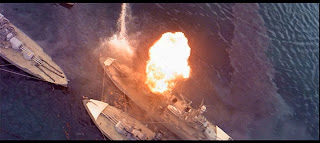
| Battleship Row conflagration aerial view. The miniature effects budget alone was $1'250'000 |
![]() |
| Torpedo strike. 'Miniaturised' water is especially convincing. |
![]() |
| The scale tends to show through in this shot, but intercut with the live action, it holds up well enough. |
![]() |
| As I mentioned, it was the full scale physical effects which to this reviewer truly stole the show. None of that lily livered greenscreen CG virtual bullshit here. It's all pure A.D Flowers and Ray Kellogg.... like kids in a candy store..... give them a camera, some TNT, a team of stunt men and alot of film and just wait for the results! |
![]() |
| Now check this out - one of the most harrowing action sequences ever filmed (see below too) where P40 taxi to runway is blasted by Zero, the result of which severs the driveshaft of the propellor, whereby the prop - now with a life of it's own - spins at full rev across the airstrip with stunt guys diving for cover!!! Jesus! |
![]() |
| The P40 propellor careening out of control. Apparently an accident which some reports claim resulted in loss of life - and other accounts state no death occurred. Whatever the truth, a monumental action set piece. |
![]() |
| Brilliant action camerawork by Michael Butler, under Ray Kellogg's direction - with A.D Flowers chillingly convincing fx- check out those stunt guys right there in the thick of it! Sensational stuff! |
![]() |
| All action set pieces were multi-camera affairs - and often "one take is all we've got" deals. |
![]() |
| Long focal length scope cinematography and multi angle cuts adds considerably to fx sequences. |
![]() |
| I'm not sure, but I think I read that much of this set piece comprised of miniatures - although if so they are remarkably convincing and suggest vast scale if it is the case. The aerial view most probably is, but the interior may be actual hangar. |
![]() |
| The outcome of the kamikazi direct hit as shown above - possibly miniature?. |
![]() |
| All the flying sequences were carefully choreographed actual replica WWII fighters flown by expert pilots, with just the close ups as shown here portrayed via mock ups in front of a front projection process screen (seen at right). |
![]() |
| Neville Brand's immortal line: "Do you still want your confirmation, sir?" |
![]() |
| More of Abbott's tank work. Apparently much more great work was shot but never made the final cut. |
![]() |
| Pyro down scaling here is very good. |
![]() |
| Torpedos amok! |
![]() |
| The scruffy painted sky backing tends to show through in some shots. |
![]() |
| A rare view of the tank, painted backing and some of the miniatures at the Fox Ranch. |
![]() |
| Effects technicians in wetsuits preparing model ships. |
![]() |
| A close view of the painted sky backing and some of the miniature dock area. |
![]() |
| Abbott and producer Elmo Williams with high speed camera set up. |
![]() |
| TORA Miniatures built under the supervision of Ivan Martin and Gail Brown. |
![]() |
| The technician lends a sense of scale to the set. |
![]() |
| Miniature USS Arizona mid capsize. |
![]() |
| Some of the ten US ship models, temporarily in 'dry dock' awaiting the go ahead. |
![]() |
| In American Cinematographer 1971, Abbott wrote extensively about the making of this film and spoke of the capabilities of the Photosonics High Speed Camera which could be cranked up to 15 times normal frame rate, though this very high speed wasn't always needed. The blowing up of The Arizona was one occasion where maximum frame rate was used. |
![]() |
| Effects chief Lenwood Ballard Abbott and producer Elmo Williams. |
![]() |
| Some of the original TORA miniatures (along with others such as one from the 1953 TITANIC) shown here as part of an auction sell off of many models and props, probably in the mid 70's. |
![]() |
| Life size partial mock up of the USS Arizona. |
![]() |
| Abbott and his camera crew with Photosonics camera. |
![]() |
| 80 foot camera crane achieves POV down view of Battleship Row miniature set as seen by attacking Zero's. |
![]() |
| It must be in the blood.... three sons of legendary, iconic special effects wizard Lawrence W.Butler were responsible, with their own independent crew, for all of the aerial, stunt and daredevil physical effect sequences - to jaw dropping effect. The team were initially contracted just to provide background plates for the aerial composites but soon found themselves recruited by Ray Kellogg to shoot all of the explosions and extremely hazardous material as Butler said in the excellent American Cinematographer article: "Ray Kellogg decided, late at night, as he usually did he wanted to get a shot of a B17 plane hitting the runway and bouncing over the camera.......I'm not so sure I'd ever do something like that again...but the enthusiasm was so terrific at the time. I have great respect for Ray and I liked him very much, and he liked me, so when he said "C'mon kid - we'll do it" and I said "okay"....and everybody looked at me as if I was crazy...and I probably was". |
![]() |
| Cable guided compressed air torpedos are launched. |
![]() |
| TORA miniatures - now what 12 year old boy wouldn't want one of these? Nowadays, probably NONE! |
![]() |
| The trailer promised.... and the film delivered. |
![]() |
| 11x14 Lobbycards - now that's something you don't see anymore. I've got a basement full of old stills, one sheets etc. |
![]() |
| The excellent 1971 special on TORA |
![]() |
| It actually means: "Tiger, Tiger, Tiger" and was the Jap codeword. |
 I'm very happy with the feedback I received from my recent Shepperton mega blog - and as always I'm grateful to those dedicated fellows out there who send me amazing material (from where, I've no clue!). Well what's on the agenda today?..... Well, shock of shocks, today's big effects extravaganza retrospective barely falls within the matte category, with just one major matte shot and a small second 'top up' shot comprising all there is paint on glass wise. It's not that I've run low on matte material (you wouldn't believe how much I have.... (over 80 GB of just images alone) but often I feel justified in examining effects shows that I love and as with today's film, were entirely justified in achieving FX Oscar status.
 My Dad took me to see TORA, TORA, TORA back in it's initial release in 1970 - where I'm fairly sure it was a 70mm release - at the now deceased Cinerama theatre in Auckland, on the giant curved screen - a relic from the short lived 3 projector system of the early 60's. As a lad who loved war films and play acting war scenarios with my mates in the dense bush near our house, where camoflage and guerilla style jungle warfare was our kick (though none of this in any way pertains to TORA's naval scenario). But these were the days when TV was black and white, movies were double bills, kids got covered in mud and scratches and the dreaded PlayStation style of 'living room combat' was still a quarter of a century (or more) away. ...as usual, I digress.
 Anyway.... on with my TORA, TORA, TORA photo tribute to a sensational true life bio-pic which still holds together 40 years down the track, largely due to it's one of a kind narrative where both the Japanese and the Americans worked on their own individual segments and brilliantly tied them together as a surprisingly coherent final product. The decision to NOT use any 'name stars' was a wise one. Superb character actors such as the always effective Martin Balsam and real life WWII hero Neville Brand just added to the sense of authenticity. The picture, despite it's two and a half hour length actually manages to rush along at breakneck pace - with facts and actual events never being sidelined by subplots or unnecessary padding - unlike so many epic war pictures. The Richard Fleischer helmed show is a tribute to this director - with his obvious talent in semi-doco features previously scoring bullseye with the excellent Tony Curtis film THE BOSTON STRANGLER a few years prior, Fleischer succinctly pulled off, what could easily have been a 'dud' in the wrong hands (think of just how many great films could have been a disaster in the wrong hands?)


 Much of the TORA fx footage would reappear over the years in films such as THE BATTLE OF MIDWAY (1976) and others, such was the quality of the footage. I should make a mention here I suppose of the more recent 2001 Michael Bay take on this event, PEARL HARBOUR. As battered by the critics as it was, I actually liked the show. In no way can it compare to TORA inasmuch as a vivid historical document, but in itself (once it get's around to the issues at hand that is) is pretty darned exciting. I'd also go so far as to name it as ILM's finest hour since the Lucas factory went computerised. For the most part, Bay tries to avoid the ludicrous fx design which so often defy gravity, laws of physics and just plain common sense (think THE AVIATOR) and sticks with CG fx shots we can believe (I'll forgive that armour piercing bomb POV that ploughs through the ammunition magazine of the Oklahoma... but just this once). In closing, I should do a blog on BATTLE OF BRITAIN (1968) some day, as that was severely overlooked as a potential Oscar contender in the special effects stakes - which were top rung all the way.